The Date That Actually Matters Isn't the Renewal Date
It's the notice period. And you're probably not tracking it.
Quick question. When is your contract actually up for renewal?
If you said the date on the contract - January 1st or whenever - you're already in trouble.
That's the renewal date. But it's not your deadline. The actual deadline - the last day you can cancel or renegotiate - is the notice period. And for most contracts, that's 30, 60, or even 90 days before the renewal date.
Miss it by one day? Locked in for another year. I've watched this cost companies anywhere from $3,000 to $100,000 on a single contract. One missed email. One forgotten calendar reminder.
of businesses struggle with renewal management
Source: MyDock365
average annual loss on unwanted auto-renewals
Source: Sirion
Two Dates. Only One Matters.
Renewal Date
When your contract officially renews or expires. Everyone tracks this. It's right there on page one. Easy to find. And almost useless for decision-making.
Notice Period
The window before renewal when you must tell the vendor you want out. Miss this window? Auto-renewal kicks in. Done. You're locked in whether you like it or not.
Here's the thing. The notice period is buried. Page 23, clause 14.2(b), some section called "Term and Termination." Nobody highlights it. Nobody sends you a reminder.
Look at This Timeline
Say you signed a contract January 1st, 2025. One-year deal, auto-renews, 60-day notice period.
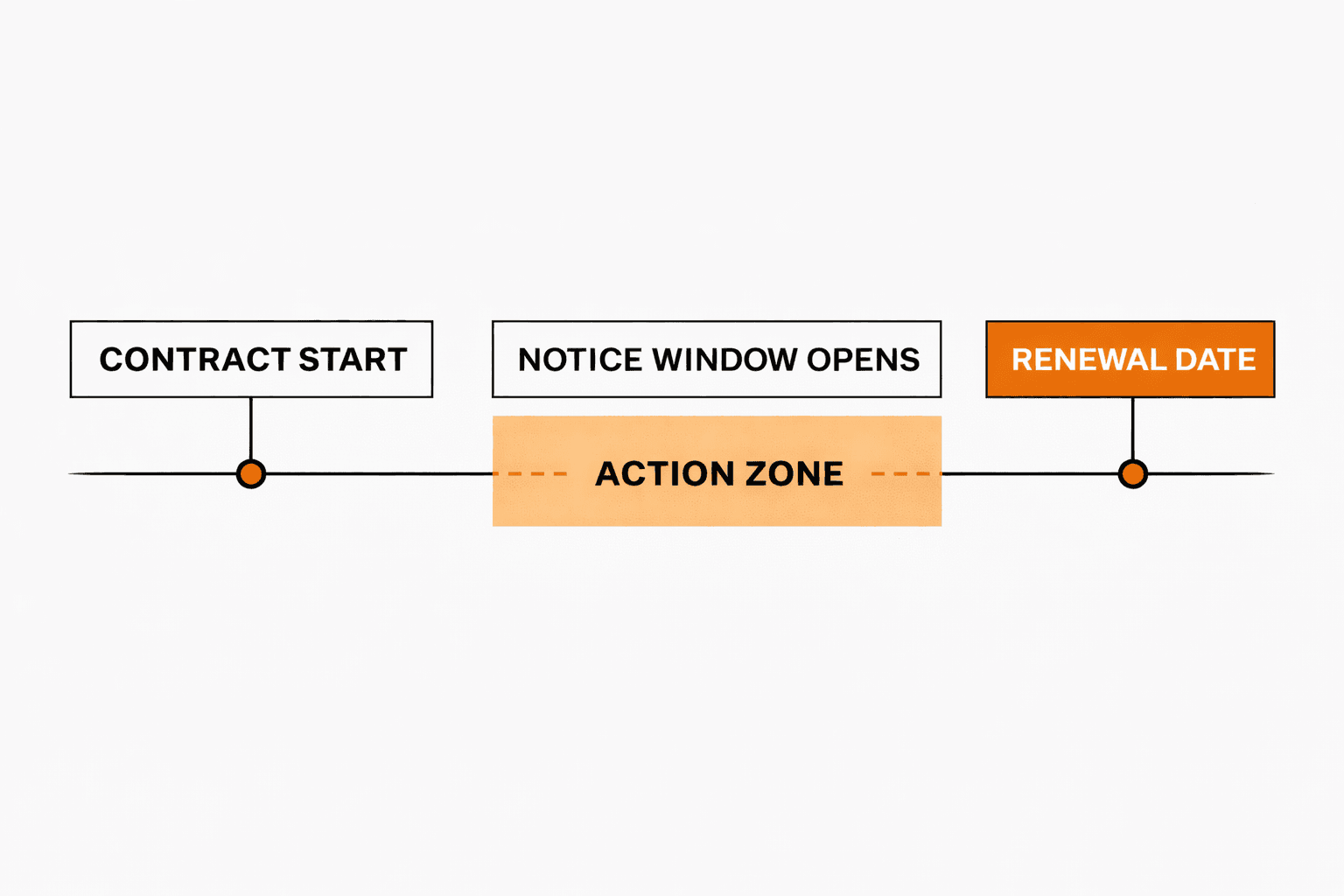
See the trap?
You're tracking January 1st. "I'll deal with this in December," you think. But December is already too late. The contract auto-renewed November 2nd, the moment your 60-day window closed. You never had a chance.
It's just subtraction. But when you're signing? Nobody does this math.
How Long Are Notice Periods, Really?
All over the place. I've seen everything from "cancel anytime" to "180 days in writing." Here's the rough breakdown:
| Contract Type | Typical Notice Period | Watch Out For |
|---|---|---|
| SaaS (self-serve) | None to 30 days | Annual plans often auto-renew silently |
| SaaS (enterprise) | 30-60 days | Price increases buried in renewal terms |
| Vendor/Supplier | 60-90 days | Multi-year commitments |
| Office Lease | 90-180 days | Break clauses with specific windows |
| Employment | 30-90 days | Probation review deadlines |
90-day notice period? That means you need to decide three months before you thought you did. Most people aren't even thinking about the contract yet.
Why Everyone Gets This Wrong
Look, it's not carelessness. The whole system is built to trip you up:
Notice periods are buried
Page 30. Clause 14.2(b). Legalese designed to be skimmed. Nobody reads this stuff carefully when they're excited to close a deal.
Vendors won't remind you
Think about it. Auto-renewal is free money for them. Some vendors actually send a "your contract renewed!" email after the notice window closes. Convenient timing.
Your calendar reminder is useless
"Contract renews Jan 1" - that's what people set. Great. By January 1st, you're just getting a reminder that you already missed your chance.
The contracts keep piling up
20-person company? You've probably got 30-50 active contracts. Who's manually calculating notice deadlines for all of them? Nobody. That's who.
"We're a small team and I've realized we're pretty bad at tracking contract renewals. A few have auto-renewed when we meant to renegotiate or cancel... Right now it's a mix of calendar reminders, spreadsheets, and 'I'll remember later' (which clearly isn't working)."— Small business owner, Reddit
Every tool tracks renewal dates. Almost none track notice periods. That's why this keeps happening. Ironclad found 92% of contract management errors come from manual processes. And tracking the wrong date? That's a manual process error waiting to happen.
How to Actually Fix This
One rule. Track the notice deadline, not the renewal date. That's it. Here's a quick audit you can do today:
Contract Notice Period Audit
Does this work? Yes. Is it tedious? Also yes. You have to actually maintain it.
Want a head start? We have a free spreadsheet template that calculates notice deadlines automatically. Or try our free Contract Tracker tool — it calculates notice deadlines, color-codes urgency, and exports to your calendar. No signup required.
The Bigger Picture
Honestly, the notice period thing is just a symptom. The real problem? Contracts get signed and then... forgotten. They end up in DocuSign. In email attachments. In some shared drive folder nobody opens. Anywhere except where decisions actually get made.
The companies that don't get burned? They're not smarter. They just have a system. Something that surfaces the right info at the right time. Without someone having to remember.
That system could be a well-maintained spreadsheet. A calendar workflow. A dedicated tool. The point is simple: renewal dates are for accountants. Notice periods are for decision-makers.
of businesses miss a contract deadline at least once a month
More than half. Every month. Missing deadlines that cost real money.
The fix isn't complicated. Track the right date. That's the whole thing.
Stop tracking the wrong date.
PactAlert alerts you before the notice window closes — not after. Never miss a cancellation deadline again.
Start free