7 Contract Mistakes You're Probably Making
The same errors. Over and over. Here's how to stop.
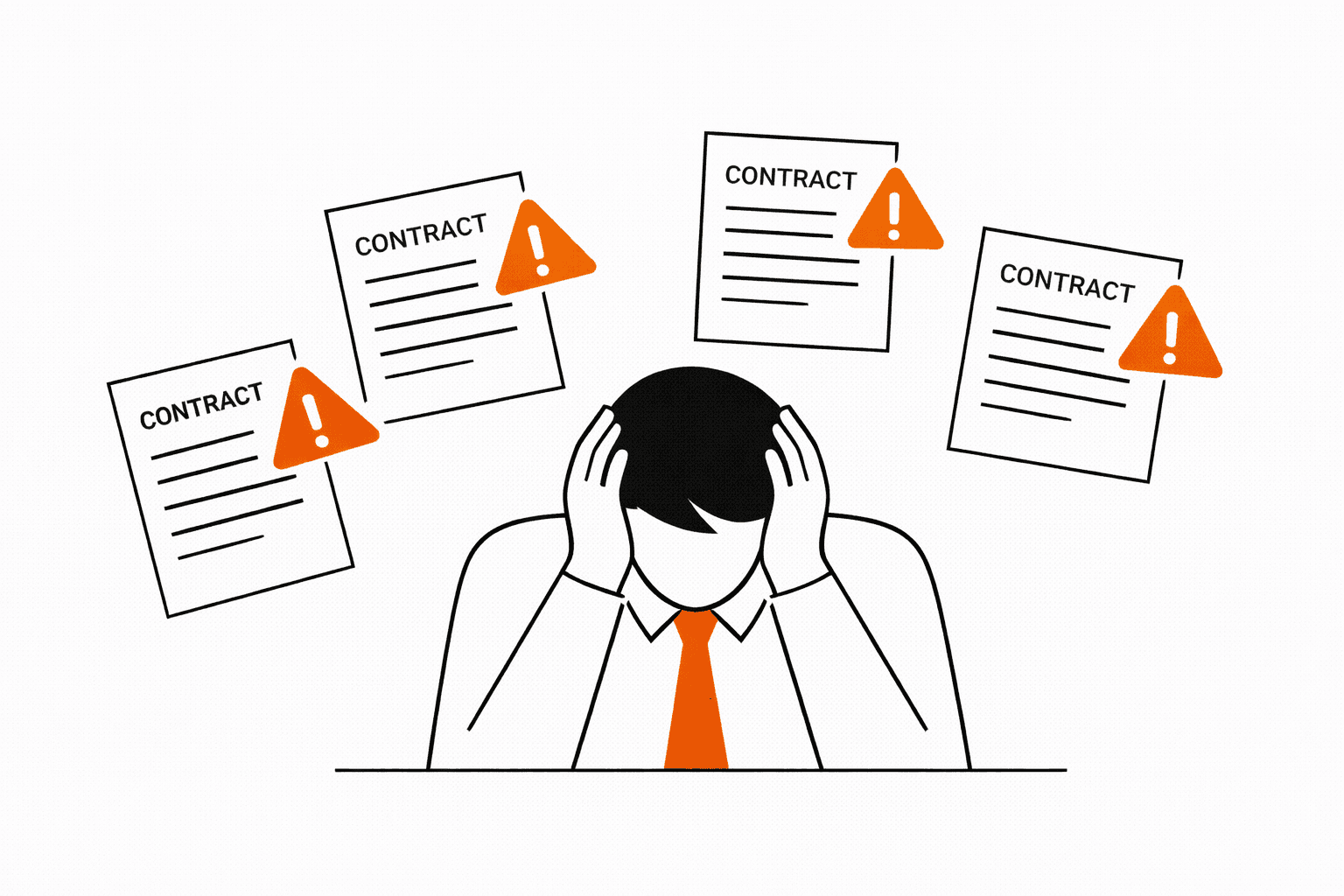
I talk to founders all the time. Ask them about their contracts. Most give you this look. The look that says: "We're handling it. Mostly. I think."
They're not. Nobody is.
The thing about contract management mistakes is they're invisible. Until suddenly they're a $15,000 invoice for software you stopped using. Or a vendor relationship that soured because you forgot a deliverable deadline. Or three different tools doing the same job because nobody tracked what you already had.
Here are the seven mistakes I see over and over. Every single one costs money. Most are fixable in an afternoon — if you know to look.
of businesses fail to track obligations systematically
Not reading auto-renewal clauses
This one's first because it's the most expensive.
89% of contracts have auto-renewal clauses. That means almost every vendor agreement, SaaS subscription, and service contract you sign will quietly renew itself — unless you actively stop it. And the window to stop it? Hidden on page 14. Clause 8.2(b). "Either party may terminate with 60 days written notice prior to renewal."
Miss that window by a single day? You're locked in for another full term.
A procurement manager on Reddit: "We once missed a renewal for over $100k because we forgot to cancel on time."
The fix: Before signing anything, find the auto-renewal clause. Write down the notice period. Calculate the actual deadline (renewal date minus notice period). Put it somewhere you'll actually see it.
Tracking renewal dates instead of notice periods
This is subtle. And it catches smart people all the time.
Say your contract renews January 1st. You put "Contract Renewal" in your calendar for January 1st. Feel good about yourself. Problem solved, right?
Wrong.
If that contract has a 60-day notice period, the real deadline was November 2nd. By January, the decision is already made. You're renewing whether you want to or not.
We wrote an entire article on this: Notice Period vs Renewal Date: The Difference That Costs Thousands
The fix: Stop tracking renewal dates. Start tracking notice deadlines. That's the date that matters — the last day you can actually make a decision.
Storing contracts without extracting obligations
Most companies have a contracts folder. Dropbox. Google Drive. That one person's desktop (you know the one). Contracts go in. Nobody looks at them again until there's a problem.
Here's what those contracts actually contain:
- •Deadlines you need to hit
- •Deliverables you owe (and they owe you)
- •SLA commitments you're paying for
- •Payment terms that affect cash flow
- •Review dates for pricing or performance
A contract in a folder is just a PDF. The obligations inside it? Those are what matter. And they're sitting there, unread, while deadlines quietly pass.
The fix: Every contract you sign should produce a list of extracted obligations. Who owes what. By when. Put those obligations somewhere trackable — not buried in the PDF.
Relying on spreadsheets nobody updates
Spreadsheets are where contract tracking goes to die.
Don't get me wrong — they're a fine starting point. We even made a free template and a free Contract Tracker tool because starting somewhere is better than starting nowhere.
But here's what happens. You build the spreadsheet. Fill it in with good intentions. For the first month, it's beautiful. Color-coded. Up to date. Then someone signs a new contract and forgets to add it. Then someone leaves and their contracts just... sit there. Then three months pass and nobody can remember if the data is accurate anymore.
Spreadsheets don't remind you of anything. They don't update themselves. They require discipline that no one has time for.
The fix: If you're using spreadsheets, accept that they need a dedicated owner. Someone who updates them religiously. Schedule a monthly contract review. Or — and I'm biased — use a tool that doesn't rely on humans remembering.
Not designating contract owners
"The team" is not an owner. "Finance" is not an owner. "We'll figure it out" is definitely not an owner.
Every contract needs a human being attached to it. One person who's responsible for the renewal decision. Who knows the deadline. Who'll be asked "should we renew this?" 30 days before it matters.
The failure mode I see constantly: someone signs a contract, leaves the company, and the contract becomes orphaned. No one knows it exists. No one's watching the deadline. It just auto-renews, silently, forever.
The fix: Add "contract owner" as a required field in any tracking system you use. When someone leaves, contract handoff goes on their offboarding checklist. No exceptions.
Ignoring small subscriptions that compound
The $15,000 CRM renewal? Everyone pays attention to that one. The $49/month tool that three people signed up for and nobody uses anymore? Invisible.
But small subscriptions add up. Fast. A 20-person startup can easily have 50+ active subscriptions. If even 10 of those are unused or redundant — at an average of $30/month each — that's $3,600/year. Quietly bleeding out of your bank account.
of SaaS spend is wasted on unused or underused tools
Source: Zylo
annual waste for a typical 50-person company
The worst part? These small tools often have the sneakiest auto-renewal clauses. Annual billing. No reminder emails. Credit card charge shows up and you think "what was that again?"
The fix: Run a quarterly subscription audit. Pull your credit card and bank statements. Tag every SaaS charge. Ask: who uses this? Do we still need it? Is anyone even logging in?
Waiting for enterprise CLM when lightweight tools exist
"We'll get proper contract management software once we're bigger."
I hear this constantly. And I get it. Enterprise contract lifecycle management (CLM) platforms cost $50K-$200K/year. They take months to implement. They're built for legal teams at Fortune 500 companies.
But here's the thing. The mistakes on this list aren't enterprise problems. They're "10 to 50 employees" problems. The damage happens now, while you're small. Waiting until you can afford Ironclad means years of missed deadlines, wasted renewals, and invisible obligations.
There's a middle ground between "spreadsheet chaos" and "$100K CLM platform." Lightweight tools. Purpose-built for small teams. Focused on the one thing that actually matters: making sure you don't miss deadlines.
The fix: Stop waiting for perfect. Start with something — a spreadsheet, a calendar system, a lightweight tool. The cost of doing nothing is higher than the cost of doing something imperfect.
The pattern
Look at these seven mistakes. They all share the same root cause: contracts are signed and then forgotten. The obligations inside them become invisible. Deadlines pass without anyone noticing. Money disappears.
The fix isn't complicated. It's just consistency. Extract the obligations. Track the deadlines. Assign the owners. Review regularly. Do these things and you'll avoid 90% of the damage.
Start here: 4 things you can do today
List every contract you have. Vendor name, annual value, renewal date. Takes an hour. Most people have never done this.
Find the notice periods. For each contract, find the clause that says how much notice you need to cancel. Calculate the real deadline.
Assign an owner to each contract. One human being. Responsible for the renewal decision.
Set calendar reminders for the next 90 days. Any notice deadline coming up? You should know about it now, not the week after.
These aren't revolutionary ideas. They're just the basics. But I've never met a company under 50 people that does all four consistently. Start there. The rest gets easier.
Done making these mistakes?
PactAlert extracts obligations from your contracts and reminds you before deadlines. Not after.
Start free